9 November 2026, 11:50
BIOMASS-FUELED COGENERATION TECHNOLOGY JOINS EVISO’S RENEWABLES PORTFOLIO, ALONGSIDE PHOTOVOLTAIC AND FUEL-CELL BIOGAS ESTIMATED CASH BENEFIT EQUAL TO EURO 7.5 MILLION (UP TO EURO 12.2 MILLION IN SUMMER)
DOWNLOAD THE PDF
Saluzzo (CN), 9 November 2026 – eVISO S.p.A. (ticker: EVISO) – a technology company, listed on the EGM – announces that it has signed new agreements with local renewable energy producers, including an agreement for the purchase of energy from a biomass cogeneration plant, in addition to new photovoltaic plants, active and in the process of activation, for a total additional capacity of 13.8 MW.
Thanks to these new agreements, eVISO reaches 143.7 GWh[1] of annual energy purchased from renewable sources in 2026 – of which 127.7 GWh[2] from photovoltaic plants, 8 GWh from biogas plants and 8 GWh from biomass plants – up +19.4% compared with the 120.4 GWh announced in July 2026 (cfr. press release of 16 July 2026) and +200% compared with the 48 GWh of 2025 (cfr. press release of 25 November 2025).
By purchasing energy directly from renewable producers, eVISO diversifies its supply sources and benefits from an improvement in the cash conversion cycle of 60 days compared with energy purchased on the electricity market (GME). With the PUN at 313.5€/MWh[3], the estimated cash benefit averages Euro 7.5 million a year, reaching Euro 12.2 million in the summer months (July and August), when over 28.5% of solar production is concentrated.
Lucia Fracassi, CEO of eVISO, commented: “The agreement for the purchase of energy from biomass expands eVISO’s direct sourcing, which already includes photovoltaic and biogas. The agreements signed bring the expected annual volume from renewable sources to 143.7 GWh, almost three times the 48 GWh of 2025. For eVISO, this growth also has an effect on financial management: compared with purchases on the electricity market, direct purchasing shortens the cash cycle for this energy by around 60 days. eVISO’s proprietary technology makes it possible to manage a wider portfolio of plants and production profiles, maintaining control over volumes and risk”.
The chart below illustrates the trend of the energy purchased by eVISO from renewable sources:
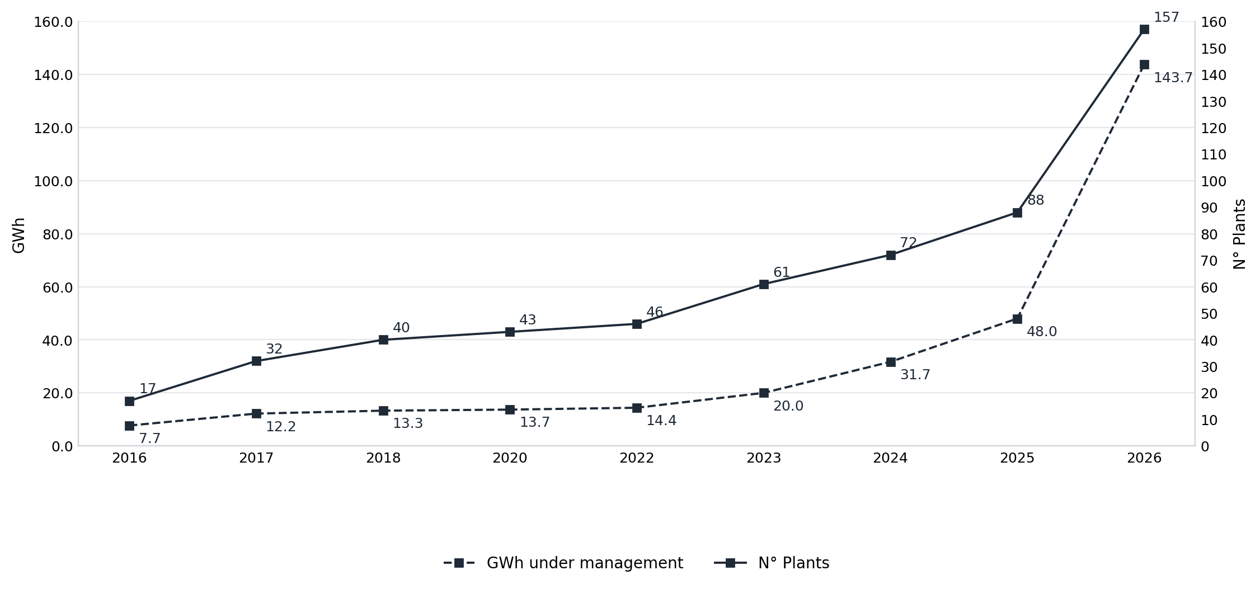
The left-hand axis shows the trend over time (years) of the GWh of energy purchased from renewable sources. The right-hand axis shows the trend over time (years) of the number of renewable-source plants supplying energy to eVISO (N° Plants).
According to the GSE Statistical Report on energy from renewable sources in Italy in 2024, 3,103 bioenergy plants were in operation at year-end, which in 2024 generated 17,237 GWh, equal to 13% of electricity production from renewable sources. Solid biomass produced 6,389 GWh, up 10.6% compared with 2023[4].
Clara Ghigo, Director of Technical, Engineering and After-Sales Accessories Services of eVISO, commented: “With the addition of the latest plants, the portfolio managed by eVISO reaches 157 plants. Photovoltaic, biogas and biomass have different characteristics and production profiles: each producer requires reliable data, continuous monitoring and a clear account of how the energy supplied is valued. I am proud to support every plant from activation to day-to-day management, maintaining the same quality of service as the portfolio grows”.
***
This press release is available in the Investor Relations section of the website www.eviso.ai.
[1] Annual production is calculated by multiplying the plant’s rated capacity by the number of equivalent operating hours. This is an estimate, since actual production depends on multiple factors and can only be forecast approximately. For the reference geography, the estimates are calculated as follows: 106.4 MW (total capacity of the photovoltaic plants) × 1,200 h (number of equivalent operating hours) plus 1 MW of biogas × 8,000 h (number of equivalent operating hours) plus 1 MW of biomass × 8,000 h (number of equivalent operating hours) = 143.7 GWh per year
[2] 106.4 MW (total plant capacity) × 1,200 h (number of equivalent operating hours) = 127.7 GWh
[3] PUN as of 9 November 2026.
[4] Sources: GSE, Statistical Report “Energia da fonti rinnovabili in Italia nel 2024”, September 2026; Terna, “Dati statistici sull’energia elettrica in Italia 2025 – Impianti di generazione”.